
Toyota Brings the Ninth-Generation Hilux to India, From ₹31.99 Lakh
Toyota Kirloskar Motor has launched the redesigned Hilux with a new dashboard, ADAS and the same proven 2.8-litre diesel, across three variants.
Created using advanced editorial technology. Reviewed and approved by ViPeople.
Photograph: Toyota Kirloskar Motor- Model
- Toyota Hilux, 9th generation
- Price range
- ₹31.99 lakh to ₹36.69 lakh, ex-showroom
- On-road, Mumbai
- ≈₹39.01 lakh to ₹44.66 lakh
- Variants
- GX 4x2 AT · GX 4x4 AT · VX 4x4 AT
- Engine
- 2.8-litre diesel, 204PS / 500Nm
- Transmission
- 6-speed automatic only
- Platform
- IMV body-on-frame, carried over
- Colours
- 6, including Emotional Red and Attitude Black
- Rival
- Isuzu D-Max V-Cross
- Bookings opened
- 26 July 2026
Toyota has just given the Hilux its biggest visual overhaul in years, and done it while keeping the one thing every owner actually cares about completely unchanged.
Toyota Kirloskar Motor has launched the ninth-generation Hilux in India, priced from ₹31.99 lakh for the entry GX 4x2 AT up to ₹36.69 lakh for the range-topping VX 4x4 AT, all ex-showroom. On-road, depending on the city, that works out to roughly ₹39 lakh to ₹45 lakh. Every variant carries the same 2.8-litre diesel engine as before, now developing 204PS and 500Nm, paired exclusively with a 6-speed torque-converter automatic. Bookings opened on 26 July, with deliveries beginning the following week.

A 4x2 automatic, finally at the bottom of the range
The genuinely new idea here is the GX 4x2 AT sitting under the two 4x4 variants. It gives buyers who want the Hilux's road presence, its cabin and its badge, without ever needing four-wheel drive, a genuinely new way into the range. Compared with the outgoing Hilux, which ran from ₹28.52 lakh to ₹36 lakh, the entry price has moved up by about ₹3.47 lakh, while the top-end VX has barely moved at all, up roughly ₹69,000. Toyota has clearly directed the increase towards the entry point of the range, which is exactly where a new automatic-only entry variant needed the investment.
The cabin gets the real news
Step inside and the change is immediate: a fully redesigned dashboard built around a 7-inch digital instrument cluster and a 12.3-inch touchscreen running Toyota's Smart Connect infotainment, with wireless Apple CarPlay and Android Auto built in. A new three-spoke steering wheel carries the Toyota lettermark in place of the old badge, matching the fresh nose treatment outside. Wireless charging, dual-zone climate control, ventilated front seats, a 360-degree camera and Toyota's full Advanced Driver Assistance suite round out the higher variants, alongside physical switchgear kept for climate and 4WD settings, which is exactly where you want a real switch on a vehicle that's meant to go off-road.
A sharper face, and a more finished rear
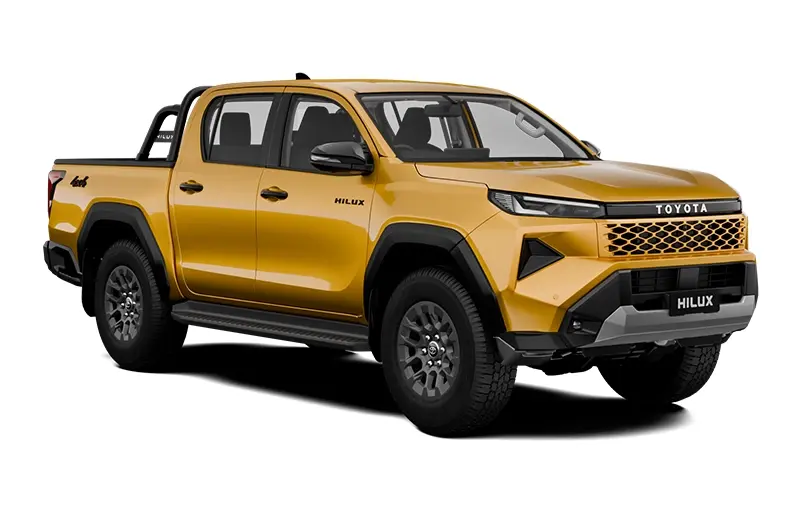
The redesign leans into a more upright, technical look: slim LED headlamps with LED daytime running lights, a honeycomb-pattern grille, and bold TOYOTA lettering across the nose in place of the old badge. In profile, black wheel-arch cladding, roll bars, a footboard for easier cabin access, and electrically retractable mirrors carry the theme back. At the rear, vertically stacked LED tail-lamps with a C-shaped signature sit above a redesigned bumper with an integrated step, making the load bed genuinely easier to reach. Six exterior colours are on offer, from Super White and Platinum Pearl White Metallic through to Emotional Red and Attitude Black, and the Hilux is available exclusively in the Double Cab body style in India.
Underneath all of it, the Hilux keeps its IMV body-on-frame platform and ladder-frame chassis, the same architecture that's carried the nameplate through deserts and monsoons on every continent it sells in. It continues to rival the Isuzu D-Max V-Cross most directly, though its body-on-frame toughness also puts it in the same conversation as SUVs like the Fortuner and the Isuzu MU-X for buyers cross-shopping between a pickup and something with a proper boot lid.
The pickup built around confidence
The Hilux has always earned its reputation through the feeling that it will keep going. The new Indian version adds modern equipment and a more current cabin while preserving the qualities buyers associate with the name. That combination matters in a market where a pickup may spend one day carrying equipment and the next travelling several hundred kilometres with a family inside.
The 2.8 litre diesel remains central to the experience. Torque gives the vehicle its relaxed strength, while the chassis and ground clearance allow it to deal with broken roads without feeling fragile. The automatic gearbox brings a little more ease to city work and long journeys, which may be as important to owners as the truck’s ability away from tarmac.
Toyota’s challenge is making the Hilux feel current without sanding away its identity. The redesigned dashboard, ADAS and wider equipment list address the daily experience. The ladder-frame character remains underneath. For buyers who want a vehicle with a sense of occasion and a genuine working ability, that balance is the reason the Hilux continues to matter.
Inside the new cabin, the change is about making a familiar tool easier to spend time in. A clearer dashboard, better connectivity and driver assistance can reduce the strain of a long day. The truck still has to feel durable, though comfort is part of durability when the vehicle is used for work and travel year after year.
The Hilux also carries a certain emotional appeal. Owners choose it because it looks ready for a journey before the journey has been planned. Toyota’s work is to keep that promise believable in the details, from the way the doors shut to the confidence the chassis gives on an imperfect road.