Peugeot Brings Rally Memory into an Electric Future with E-T16 and RCZ Vision
Two world-premiere concepts give Peugeot different ways to talk about performance. The E-T16 reaches back to the 205 T16, while the RCZ Vision explores a high-voltage electric coupé. Both remain visions, with the production E-208 GTi and 9X8 adding a present-day motorsport thread to the Paris display.
ViPeople Road & Track DeskPublished Updated 18 min read
Photograph: Supplied to ViPeople
Audio articleListen to this storySerena (Enhanced) · English UK
Peugeot has brought two very different ideas of speed to the Paris Motor Show. The E-T16 Concept looks back to the 205 T16, whose World Rally Championship titles in 1985 and 1986 gave the name a hard-earned place in the company’s competition history. Beside it, the RCZ Vision points towards a more sculptural electric coupé. Both are concept cars that describe the company’s direction before any production plan is announced.
The display has a useful third voice. A 1986 205 GTI sits with the new E-208 GTi, while the 9X8 represents Peugeot Sport’s present work in the FIA World Endurance Championship. The sequence is deliberate: a road car that became an enthusiast’s touchstone, a modern electric GTi and a current racing prototype. The concepts sit between those histories and invite visitors to imagine what comes next.
Peugeot has arranged the cars across a new stand of nearly 1,300 square metres in Hall 4. The E-T16 and RCZ Vision make their world premieres at the centre, with the Polygon nearby as a rolling laboratory for ideas that the company says will begin reaching future models from 2027. Around them sit the road-going GTi pair, the 9X8 and the wider range. It is a carefully staged walk from memory, through current competition and into a future the company has yet to turn into a showroom programme.
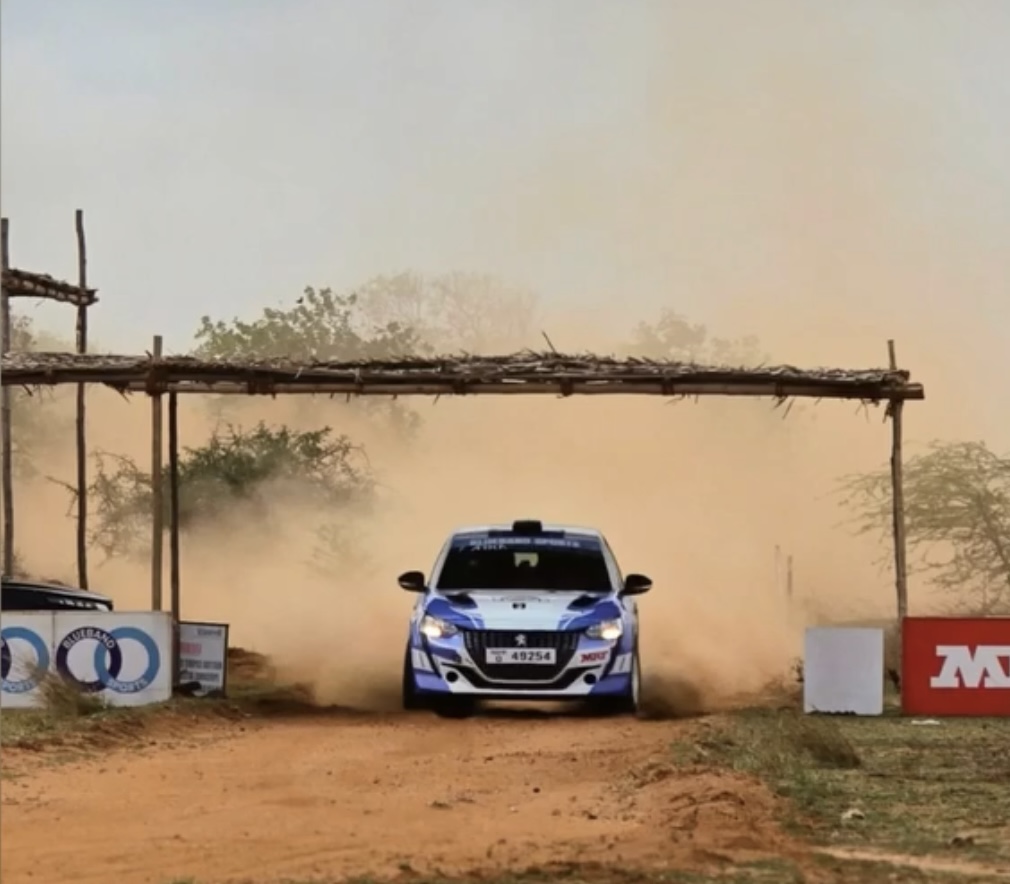
Jason Saldanha and Srinivas Murthy P V attack a Coimbatore stage in their Peugeot 208 Rally4, a rally-context image alongside the Paris concepts.Photograph: Supplied to ViPeople
The E-T16 carries a competition name into a new era
Peugeot gives the E-T16 a muscular hatchback form and describes it as a vision of the next E-208. The official figures are startling: 816 horsepower and a claimed 0-300 km/h time of 16 seconds. Those numbers describe the scale of the company’s ambition. No customer-ready specification accompanies them. Peugeot presents it as the most powerful model in its history, with the 208 T16 Pikes Peak prototype the only machine it places above the E-T16 on power.
Peugeot Sport has given the concept three electric motors, one at the front and two at the rear, for a combined 816 horsepower. Torque vectoring is designed to distribute power between the rear wheels and across the axles according to available grip. The concept has three driving modes, including a Track setting that changes power delivery, torque distribution and suspension settings. These details make the E-T16 more than a styling exercise. Peugeot is presenting it as a working illustration of how its competition engineers might shape an electric performance car.
The published performance figures are unusually specific for a concept. Peugeot claims 0 to 100 km/h in 2.5 seconds and 0 to 300 km/h in 16 seconds. It also says the E-T16 can complete three laps of the Nürburgring Nordschleife, more than 60 kilometres, in Performance mode without limiting power. The company describes an 800-volt system, an 85 kWh battery, up to 400 kilometres of WLTP range and a 10 to 80 per cent charge in under 15 minutes. They remain manufacturer figures for the concept, with no independent road test behind them.
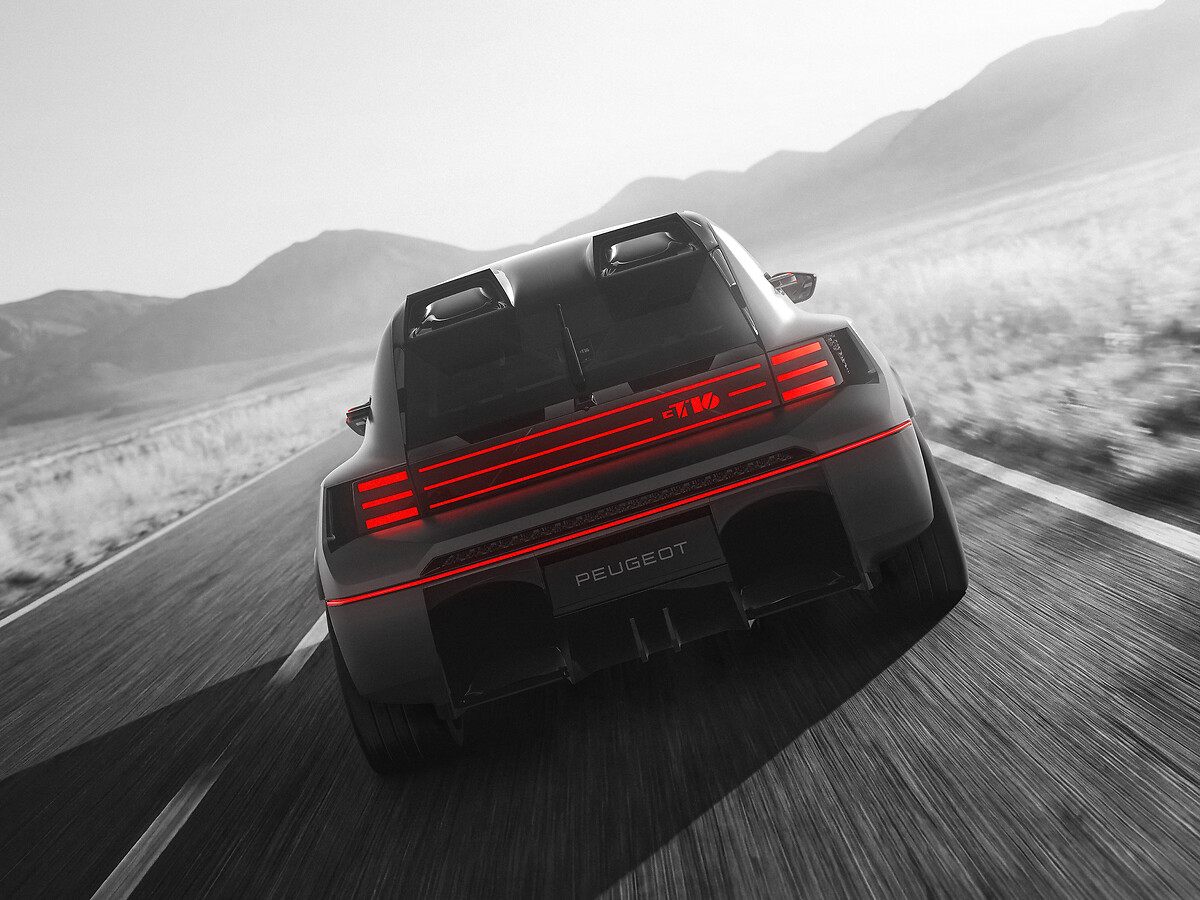
Peugeot’s official rear three-quarter view shows the E-T16 on the road, its broad stance finished with a full-width red light signature.Photograph: Peugeot / Stellantis Media
The reference to the 205 T16 reaches beyond a name. In the mid-1980s, Peugeot took a compact shape and made it a central character in rallying’s most demanding era. The original car’s success is why the new concept has a clear inheritance to carry. Its stance and visual weight are meant to recall the force of that machine, while the electric powertrain changes how the force is delivered and controlled.
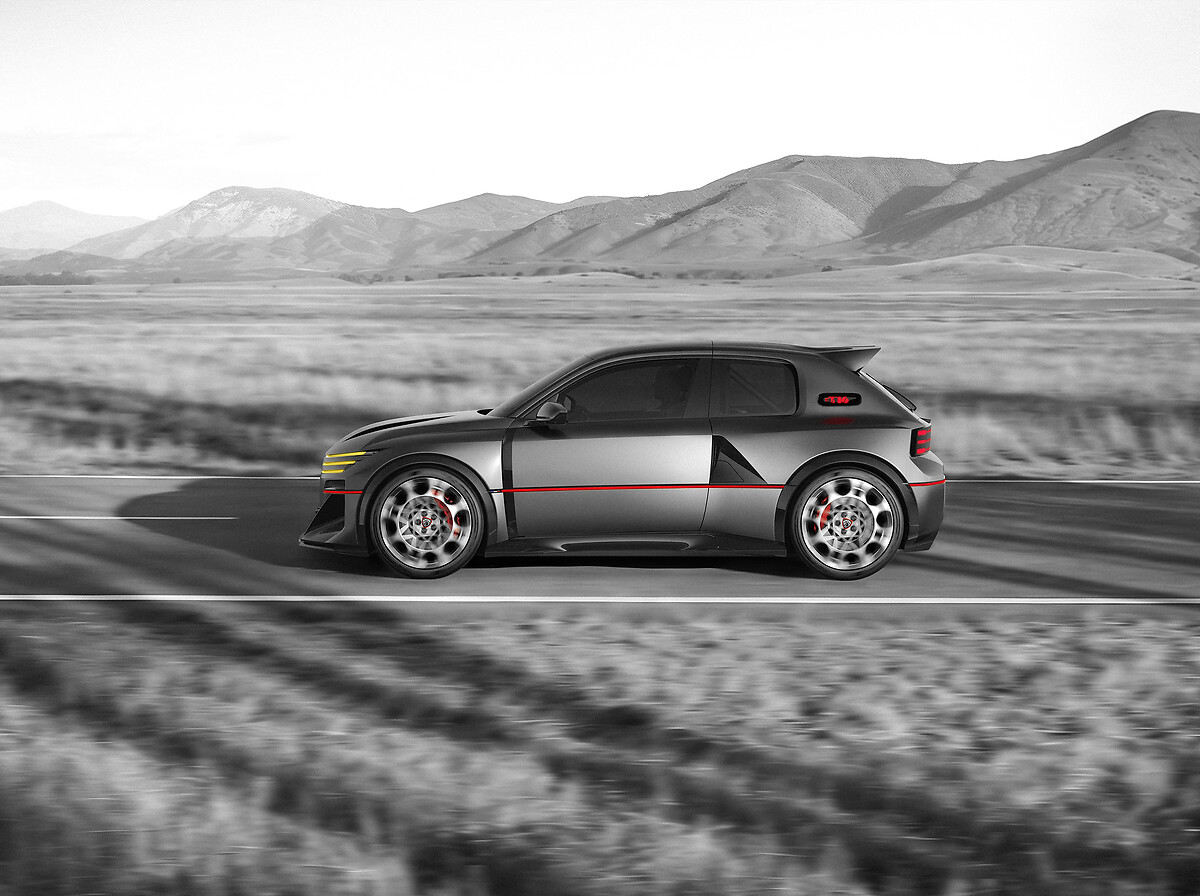
The visual references are particular. Winchester Matte Grey recalls the original car’s finish, while a fine red line runs around the body in reference to the 205 T16’s pinstripe. The intake ahead of the rear wheel has been given a new job as the charging port and door-release area. Most theatrical is the rear body section, which lifts to expose the electric motors and suspension. Peugeot has preserved a competition car’s appetite for showing its workings, even as the machinery beneath the body has changed.
The E-T16’s side profile is set against loose gravel and a mountain backdrop, bringing the rally reference into the concept’s visual language.Photograph: Peugeot / Stellantis Media
Peugeot says the E-T16 was developed with Peugeot Sport. The company has paired the concept with its Hypersquare control, a compact steering interface linked to steer-by-wire technology. Removing the conventional mechanical connection between the steering wheel and front wheels makes the system itself part of the design story. It also raises a question any future road-going version would have to answer: how to make a new control feel intuitive through a fast corner, a tight turn and a full day of ordinary driving.
The Hypersquare appears across the three concepts on the stand, including the Polygon, which Peugeot has used as a rolling laboratory for steer-by-wire and its next steering interface. The company says the system can bring quick responses at speed and easier hand movements during low-speed manoeuvres. Those benefits will have to be judged from behind the wheel. For now, the show gives Peugeot room to make the controls visible and let visitors experience their shape on a simulator.
Inside the E-T16, the next-generation i-Cockpit places a 21-inch panoramic display above the Hypersquare. Carbon fibre, anodised aluminium and technical mesh carry the competition atmosphere through the cabin, while bucket seats use a red stripe that echoes the line around the body. The rear opens to show the structure and the two motors mounted there. Peugeot says the space also includes room for two helmets, a small detail that makes the car feel conceived around the habits of people who go to a circuit.
RCZ Vision takes the conversation towards the road
The RCZ Vision has a different task. Peugeot describes it as a design and technology manifesto shaped around the brand’s “Feline Future” language. It draws on the memory of the first RCZ coupé, sold from 2009 to 2015, then moves the idea into an electric architecture built around a solid-state battery developed with Factorial Energy and a 1,000-volt system.
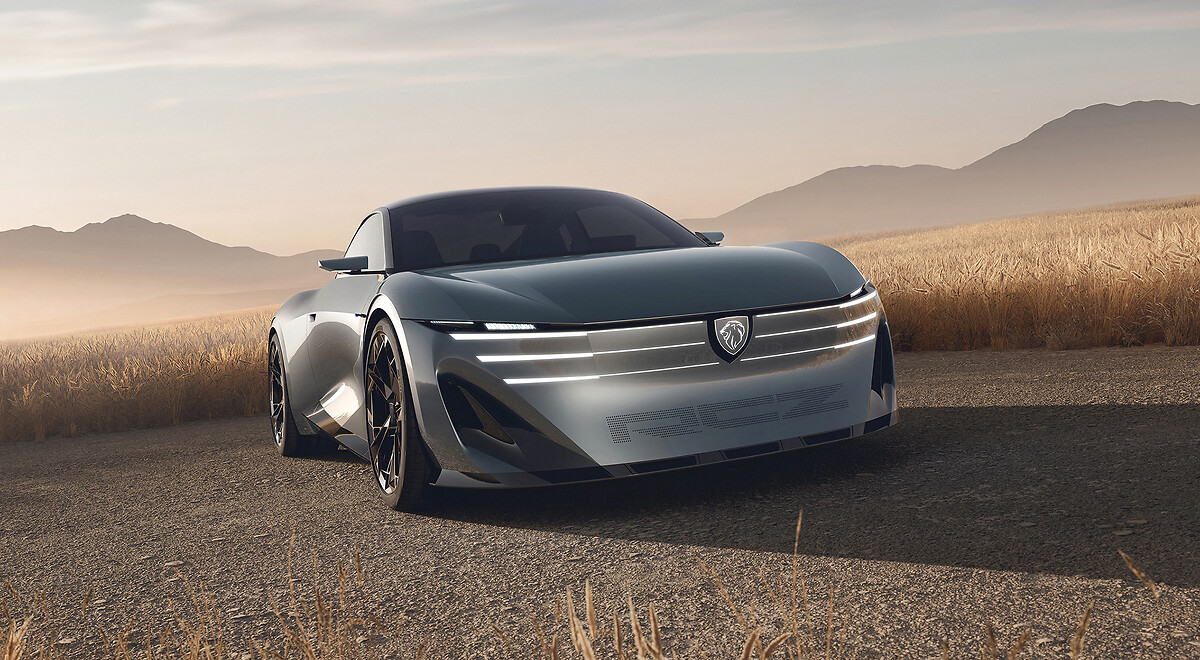
The original RCZ gave Peugeot a distinctive coupé with a double-bubble roof and a sculptural rear screen. The Vision keeps that memory close, then stretches it into a low electric form with a glass-like cabin and pronounced shoulders. Peugeot calls its new design language Feline Future and sets out five principles for it: freedom, courage, elegance, inner force and instinct. Those words are corporate shorthand, yet the car’s compact lamps, broad flanks and low roof give them a visible shape.
The RCZ Vision is shown from the front on a quiet road, a separate design direction from the E-T16’s rally-shaped stance.Photograph: Peugeot / Stellantis Media
For the concept, Peugeot lists 500 horsepower and a range of up to 600 kilometres. It says the battery can move from 10 to 80 per cent charge in ten minutes. These are manufacturer claims for a vision car, with no independent road test or production specification attached. Their value is in showing where Peugeot wants the discussion to go: long-distance electric performance, fast charging and a cabin where the driver remains physically involved.
The battery is described as a 110 mm solid-state pack developed with Factorial Energy, paired with a 1,000-volt architecture. Peugeot gives a consumption target of 11.5 kWh per 100 kilometres, while marking that figure for confirmation. The distinction matters when reading the range and charging claims. This is a compact package of ambitious targets, and the information is valuable as a statement of engineering direction. It does not yet tell us what a production RCZ would weigh, cost or deliver in everyday conditions.
The RCZ Vision also uses Hypersquare and a new interpretation of the i-Cockpit, with transparent MicroLED displays. The aim is to reduce the distance between the driver’s hands, the information and the car’s response. Whether the production cars that follow will preserve these details is not yet clear. As a concept, the RCZ Vision is there to make the design team’s priorities visible.
Hypersquare is paired with steer-by-wire, so an electronic system controls the front wheels in place of a mechanical steering link. Peugeot says the steering control needs slightly less than one full turn from lock to lock at low speeds, compared with around three turns for a conventional wheel. The concept also introduces brake-by-wire, replacing the hydraulic connection from pedal to brakes with electronic control, and previews Level 2++ hands-free assistance. Each system makes the cabin cleaner and the response more configurable. Each would also need to earn the driver’s trust in a real car.
The transparent MicroLED displays show Peugeot’s interest in restraint as well as novelty. The company says drivers can configure the information in front of them and allow the central screen to disappear when it is not needed. The active rear spoiler remains hidden while the car is stationary and deploys in motion. Even the wheel design is part of the efficiency story: the concept uses 21-inch forged wheels at the front and 22-inch wheels at the rear, with a spoke pattern intended to use less material.
Peugeot also links the cabin to material choices. Its PELINOVA upholstery uses recycled offcuts from the leather-goods industry, including material that would otherwise go unused. The idea sits naturally beside a concept that spends so much attention on screens and electrical architecture. The cabin has to feel desirable in the present moment, where the hands touch the steering control and the seats carry the body, as well as pointing towards a future battery system.
The GTi bridge is already real
The E-208 GTi offers a more concrete point of reference on the stand. Peugeot says the production car uses a 281-horsepower electric motor and reaches 100 km/h from rest in 5.5 seconds. It is the first fully electric GTi, a name whose appeal has always rested on lightness, direct responses and the pleasure of using a car on a familiar road. The challenge is to make those qualities feel present in an electric car, so the badge continues to stand for a particular way of driving.
The older car on the stand is specifically a 1986 205 GTI 1.9 rated at 130 horsepower. Placing it beside the E-208 GTi gives the badge a real physical history to answer to. The new car is more than twice as powerful, and its acceleration figure is the sort that would have sounded extraordinary in the original’s era. Peugeot’s task is to translate the old car’s compact, responsive character into a different weight, powertrain and set of expectations.
That is why the old 205 GTI matters in the display. Its presence gives the new electric car a physical predecessor, while the E-T16 puts a more radical, competition-minded idea on the same stage. The 9X8 brings in endurance racing, where efficiency and outright speed have to work together over distance. Peugeot has arranged the stand so that past, present and possible future can be read in one walk.
The 9X8 completes that argument with a machine built for a different kind of proof. Endurance racing asks a car to make speed repeatable over hours, and its presence places Peugeot’s latest road-car ideas alongside current competition engineering. Visitors can also try the Hypersquare through simulators near the Polygon. That matters because a steering device is difficult to judge from a photograph. A hand on the control, even in a simulator, gives the proposal a more immediate dimension.
The photograph here brings the story back to India, where Jason Saldanha and Srinivas Murthy P V drive a Peugeot 208 Rally4 on a dusty Coimbatore stage. That car belongs to a working rally programme, with a crew reading the road and using the machinery over a competitive stage. Its performance is measured in traction, precision and how well the car carries speed over changing surfaces. The E-T16 is still a promise on a show stand. The Rally4 makes its argument one corner at a time.
Paris concepts point forward while production remains an open question
The E-T16 and RCZ Vision are polished enough to make their futures feel close. Their technical claims are also large enough to demand careful reading. Neither concept comes with a confirmed production schedule. The E-T16’s output and acceleration remain show-car figures, and the RCZ Vision’s battery, charging and range claims have not been set out as a customer-ready vehicle specification.
That leaves the most interesting question open. Peugeot is trying to retain the emotional language of its sporting cars as the engineering changes around them. The E-T16 makes its case through the echo of a rally legend and a startling electric power claim. The RCZ Vision asks whether a future coupé can make advanced battery technology feel desirable and direct. The E-208 GTi is the nearer answer on the stand, while the concepts let the company speak further ahead.
Paris gives Peugeot a rare chance to place all of those ideas together. A concept earns its place when it makes a company’s next questions visible. Here those questions concern a compact steering gesture, a driver-centred cockpit, a performance identity and a connection to competition that still matters to people who watch from a gravel bank.
The three cars leave different questions in the mind. The E-T16 asks how much of rallying’s visual drama and urgency can move into an electric hatch. The RCZ Vision asks whether advanced battery chemistry and electronic controls can still feel intimate from the driver’s seat. The E-208 GTi carries a nearer, production-based answer, and the 9X8 represents competition in the present tense. Peugeot has given Paris a coherent set of ideas. The harder work begins when it chooses which of them belong on the road.
Comments0
Join the ViPeople conversationSign in with Google to comment, like and save stories.Continue with Google