Buddh Gives India’s Racing Festival a New Kind of Weekend
F4 India and the Indian Racing League arrive at Buddh International Circuit on 31 October and 1 November. For the festival, it is a new venue. For Indian single-seater racing, it is a return to one of the country’s most recognisable international circuits, with a live title fight already taking shape.
ViPeople Editorial DeskPublished 9 min read
Photograph: Free Press Journal
Audio articleListen to this storySerena (Enhanced) · English UK
Buddh International Circuit has been part of Indian motorsport’s memory for more than a decade. This weekend, the memory becomes a working race track again. F4 India and the Indian Racing League are at Greater Noida on 31 October and 1 November for Round 4 and Round 2 of their 2026 seasons, bringing two formats of domestic single-seater racing to a circuit built for international competition.
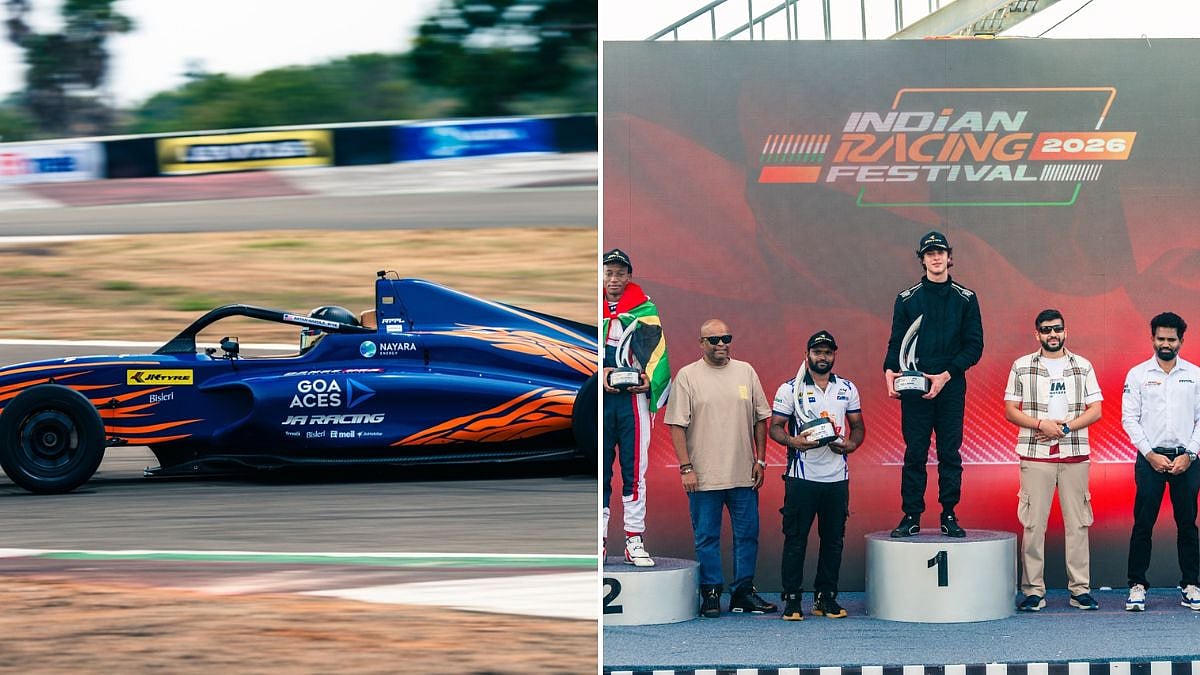
F4 India Round 1 at Kari: race action alongside the podium ceremony. The championship now takes its fight to Buddh International Circuit.Photograph: Free Press Journal
It is the Indian Racing Festival’s first visit to Buddh. For the circuit, it is a return to a calendar that has been quiet since India’s Formula One years. The wider significance lies in the opportunity to see an Indian championship occupy a venue many fans know from television and from the three Formula One races held there between 2011 and 2013.
The programme combines two distinct competitions. F4 India is a driver championship in closely matched single-seaters, designed to give developing racers a structured route into circuit competition. The Indian Racing League has city-based teams and a wider franchise identity. Both arrive as part of the Indian Racing Festival, so the weekend can hold a personal title fight and a team-based series within the same event.
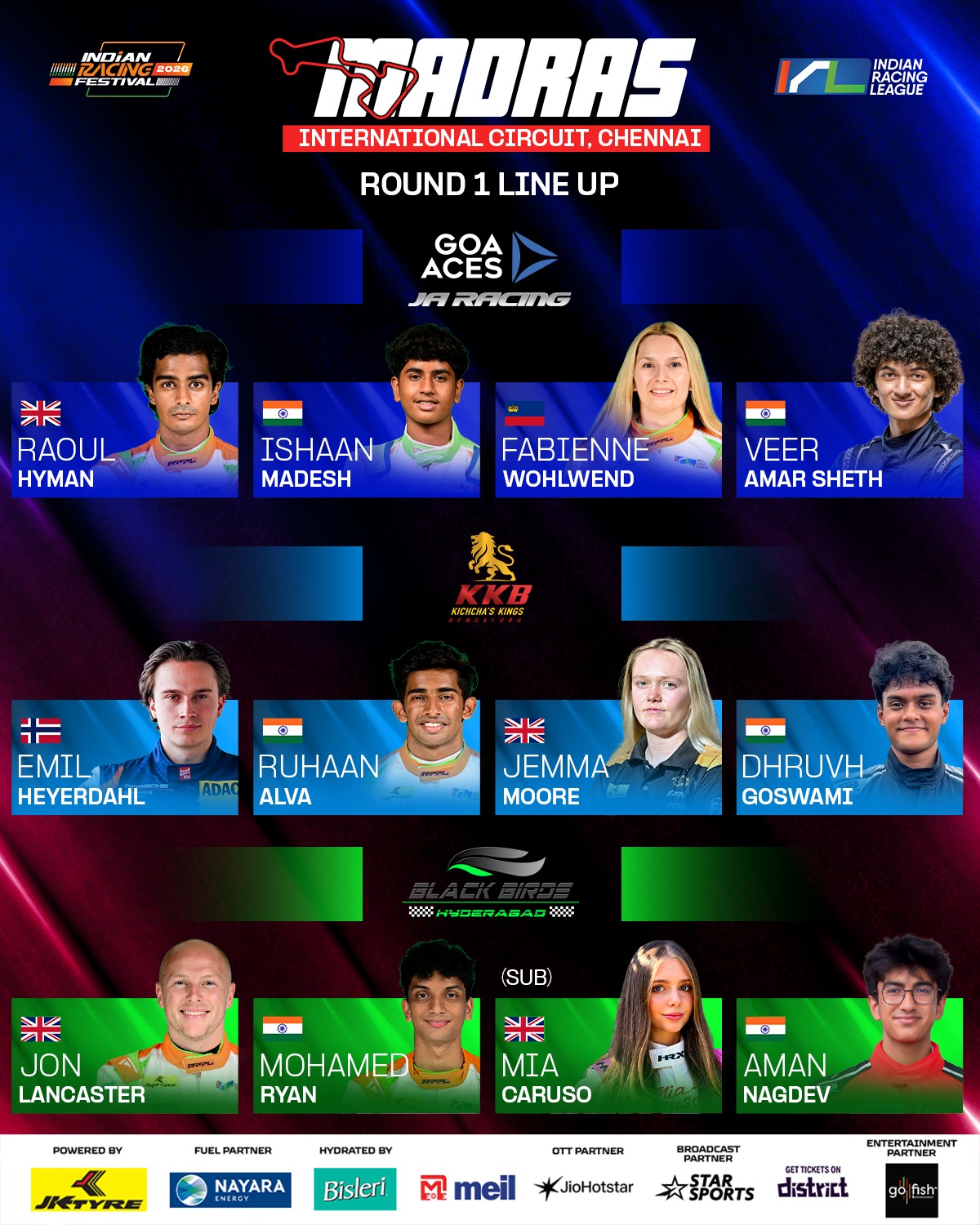
The official 2026 Indian Racing League Round 1 lineup graphic for Chennai, showing drivers from the Goa Aces, Kichcha’s Kings and Black Birds teams before the series moved to Buddh.Photograph: Indian Racing League / RPPL
A familiar circuit with new reference points
Buddh measures 5.125 kilometres. The track’s long straights lead into heavy braking zones, while the flowing sequences reward drivers who connect each corner to the one that follows. That mix gives the engineers a wide set of questions about balance and tyre use. It asks the drivers to build a new map of braking points, turn-in references and places where they can carry speed.
The field has raced at Madras and Kari earlier in the year. Those tracks have their own characteristics and established references. Buddh changes the scale and the pace of the lap. Practice becomes especially useful because drivers can compare what they feel with timing and data. A small improvement on one corner can affect the next section, and the quickest way through a new circuit is often to understand the whole sequence.
For spectators, the return gives domestic racing the space of a permanent Grand Prix circuit. The cars and teams can use a venue with broad viewing areas and a full paddock, while the audience sees the working detail around the racing. The circuit provides the setting. The drivers and teams will give the weekend its character.
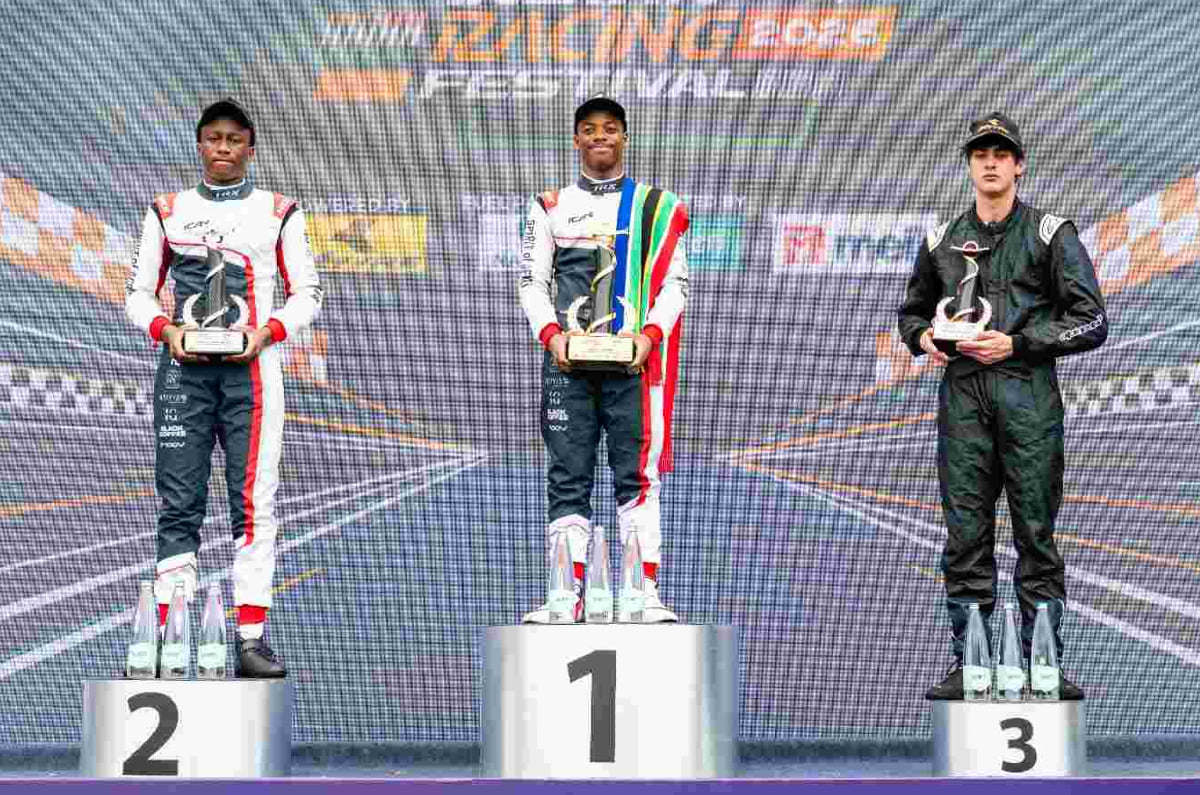
The F4 India Round 2 podium at Kari, where Luviwe Sambudla added wins and strengthened his championship challenge.Photograph: Free Press Journal
Sambudla’s position comes from the work of a full season, with the Madras result giving him two wins and a useful cushion. A 21 point margin is meaningful in a championship, though it is not a guarantee across a weekend that contains qualifying and multiple races. Every start creates a new problem. A driver can make up ground through clean execution, while a mistake or a slow launch can turn a comfortable lead into a defensive exercise.
Kyriakou’s response will be shaped by how quickly he and the team make sense of the circuit. Practice is where braking references and gear choices begin to settle. Qualifying then gives each driver a short window to put a clear lap together in traffic. At Buddh, the long straights can bring cars together before heavy braking zones. That makes positioning valuable, while leaving the driver to judge how much room is available when the field arrives together.
Mehta’s Madras win has a different significance. The 15-year-old became the youngest winner in F4 India history, a milestone that makes his next outing more visible. The title fight is the main thread, but a development championship is also measured in how drivers turn a first breakthrough into repeatable performance. A new circuit removes some familiar reference points. It gives the young field another chance to show how quickly it can learn.
Sambudla brings the championship lead to Buddh
Luviwe Sambudla arrives with 138 points, 21 clear of Aris Kyriakou. The lead reflects a strong run at Madras, where Sambudla won twice in Round 3. The margin is large enough to make him the weekend’s reference point and close enough to keep the contest open. A title leader has to score well across the whole programme, especially when the track is new to the field.
Kyriakou has the nearest route back into the fight. He knows the lead can move quickly across a weekend, but the way to challenge it is through execution. Qualifying sets the starting position. The race demands a clean launch, attention to traffic and the judgement to choose when to attack. At a circuit with long straights, a driver can use the tow to close a gap, though the braking zone still has to be managed.
Aaron Mehta also arrives with a result that belongs in the season’s story. At 15, he became the youngest driver to win an F4 India race after a narrow success at Madras. A breakthrough matters most when it becomes a foundation. The next race asks the young driver to repeat the work under different circumstances, and a new circuit removes some of the comfort that comes from knowing the last venue.
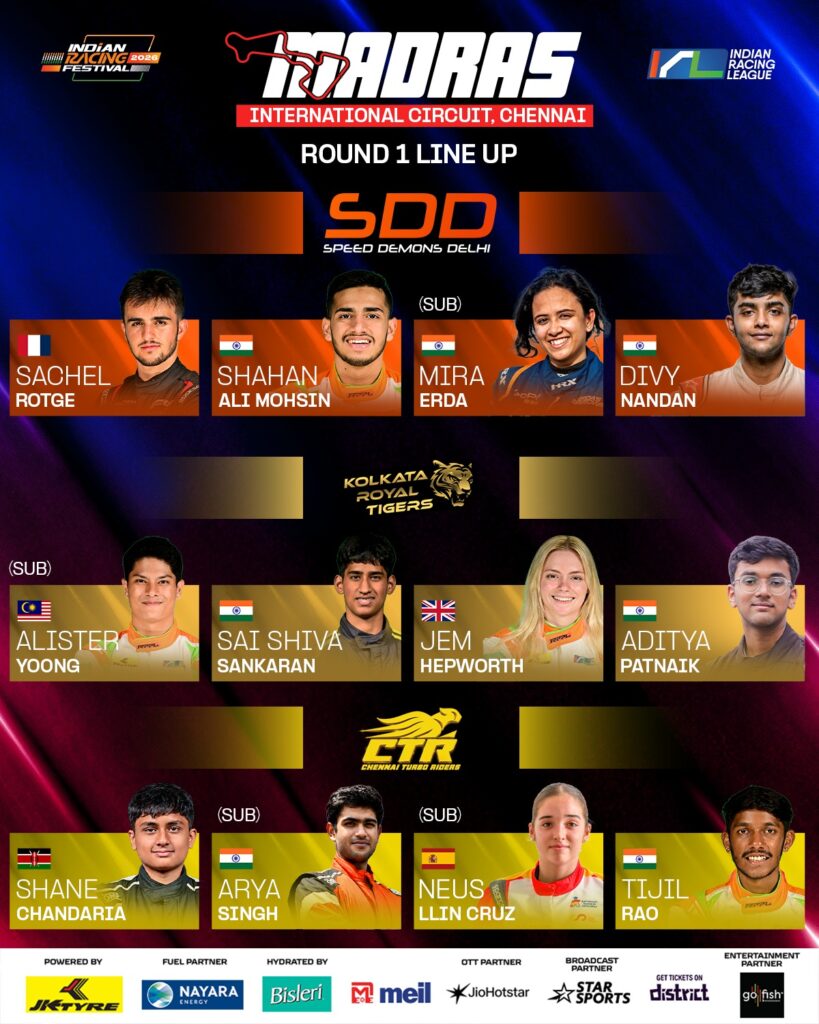
The remaining teams in the official Indian Racing League Round 1 lineup graphic: Speed Demons Delhi, Kolkata Royal Tigers and Chennai Turbo Riders.Photograph: Indian Racing League / RPPL
The Indian Racing League brings a team-based dimension to the same weekend. Its cars and format give the paddock a different rhythm from the single-seater championship, with teams balancing driver line-ups and the points gathered across the programme. Round 2 at Buddh is one stop in a season that will return to the circuit in late November before closing with a night-race event in Navi Mumbai on 5 and 6 December.
Putting the two championships together makes the weekend broader for the venue and more demanding for the organisers. Track sessions, paddock movements and spectator access have to fit into a shared timetable. The source calendars confirm the dates and rounds. Detailed session timings should be taken from the event schedule as issued, since a programme can change as the weekend approaches.
For the drivers, a festival weekend also means sharing attention with another category. That can bring more people through the gates and a fuller story around the circuit. It asks each championship to give its own races a distinct identity. F4 is a direct contest between young single-seater drivers. The IRL adds team colours and a different route through the event. Both are part of the same effort to make circuit racing visible to a wider Indian audience.
The Indian Racing League adds a team story
The IRL gives the festival a team identity that travels between rounds. Its city-based entries offer spectators a side to follow across the season, even as the drivers and results evolve. Round 2 takes that format to a large permanent circuit, where teams have to build a setup for a longer lap and prepare for the race programme without a deep history of data from this season at Buddh.
The series is also part of a broader effort to make domestic circuit racing easier to follow. A city team can give a fan a recognisable banner. The F4 grid gives the weekend individual names and a clear championship table. The festival places both in one event, along with the paddock and support activity that help newcomers understand what happens between sessions.
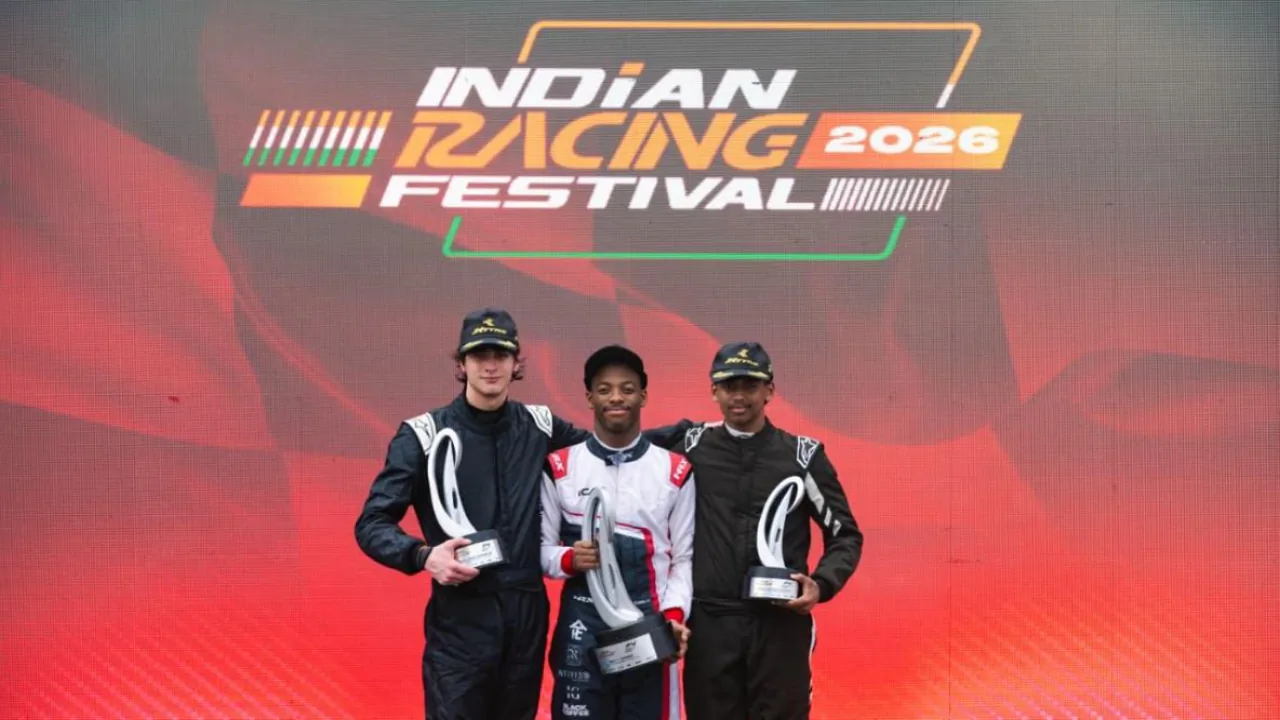
The F4 podium at Madras after a weekend of three close races and two championship turning points.
Two visits to Buddh, then a night-race finale
The calendar brings the festival back to Buddh on 28 and 29 November before the season concludes at the Navi Mumbai street circuit on 5 and 6 December. That second BIC meeting gives the drivers a chance to turn this weekend’s notes into a more complete reference. The final in Navi Mumbai will then introduce a different kind of circuit and another set of decisions.
For the title contenders, the immediate task is straightforward in principle and demanding in practice: collect points, avoid unnecessary losses and learn the track quickly. For the teams, it is to prepare cars that can cope with a new circuit while managing the timetable of two championships. For the audience, it is a chance to see local racing return to one of the country’s most prominent venues.
Buddh’s value this weekend will be measured in more than nostalgia. The circuit offers a new challenge to drivers already building careers, and a large platform for a domestic series with a title fight under way. The first start will replace the old reference points with new ones. By Sunday, the standings will show which crews found their rhythm fastest.
A return to Buddh gives the season a wider stage
Buddh International Circuit measures 5.125 kilometres and has hosted major international racing. The circuit’s long straights and heavy braking zones offer a very different test from the shorter rhythm of Madras International Circuit, where the F4 field last raced. Drivers need to learn where the car can stay committed and where they must manage speed before turning in. Engineers have to read tyre behaviour and balance through a lap with several contrasting demands.
The Indian Racing Festival’s first visit to BIC is significant because the circuit has been absent from the country’s main international single-seater conversation for 13 years. The return places developing Indian talent on a track with a larger international history. It also gives fans a chance to see the series in a venue whose scale is familiar from global events. The value of that exposure will depend on how the weekend is organised and how the racing uses the circuit.
A new venue also makes comparisons harder. Last round’s order cannot simply be projected onto this one, since braking points, surface grip and the available passing opportunities have changed. The championship standings still matter. So do the details learned in each session, especially for younger drivers moving quickly between circuits. The weekend is a test of speed and adaptation, with a second visit to BIC later in November giving the teams a chance to measure their progress.
The season’s final move to Navi Mumbai on 5 and 6 December adds another contrast. A night-race finale will ask the field to adjust again, with a street circuit and evening conditions replacing Buddh’s broad permanent layout. The November BIC return sits between those experiences. The calendar gives F4 India and the IRL three distinct settings in the closing stretch, and each one can shape the final standings in a different way.
The calendar places the BIC visit at Round 4 for F4 India and Round 2 for the Indian Racing League. The different round numbers reflect separate championship journeys taking place on the same programme. F4’s title fight has already developed through earlier rounds, while the IRL is still building its season. Following both requires a little attention to the format. The shared venue does not mean the same points table or the same competitive question.
For F4 India, Sambudla’s 138 points and Kyriakou’s 117 give the weekend a clear championship focus. The 21 point gap is large enough to shape strategy, but the points still have to be earned in the races. A leader has to avoid giving away easy positions. A challenger needs to convert pace into results while keeping the season in view. The figures from Madras provide a starting line for the conversation, not an answer to it.
Mehta’s record as the youngest F4 India race winner brings a third strand into the weekend. His win at 15 is a significant milestone for the series and for the driver. It does not make the next step automatic. Young drivers continue to learn through new tracks, changing weather and pressure from experienced rivals. The Buddh races will offer another measure of how he turns a landmark result into sustained progress.
Comments0
Join the ViPeople conversationSign in with Google to comment, like and save stories.Continue with Google