Cuorerosso Gives Alfa Romeo’s Future a Red Heart and an Open Road
Alfa Romeo’s 4.7-metre 2+2 concept is a study in proportion, touch and driver connection. The brand calls it a manifesto for future models, with several possible energy paths and a V6 hybrid described only as an imagined Quadrifoglio expression.
ViPeople Road & Track DeskPublished Updated 18 min read
Photograph: Alfa Romeo / Stellantis Media
Audio articleListen to this storySerena (Enhanced) · English UK
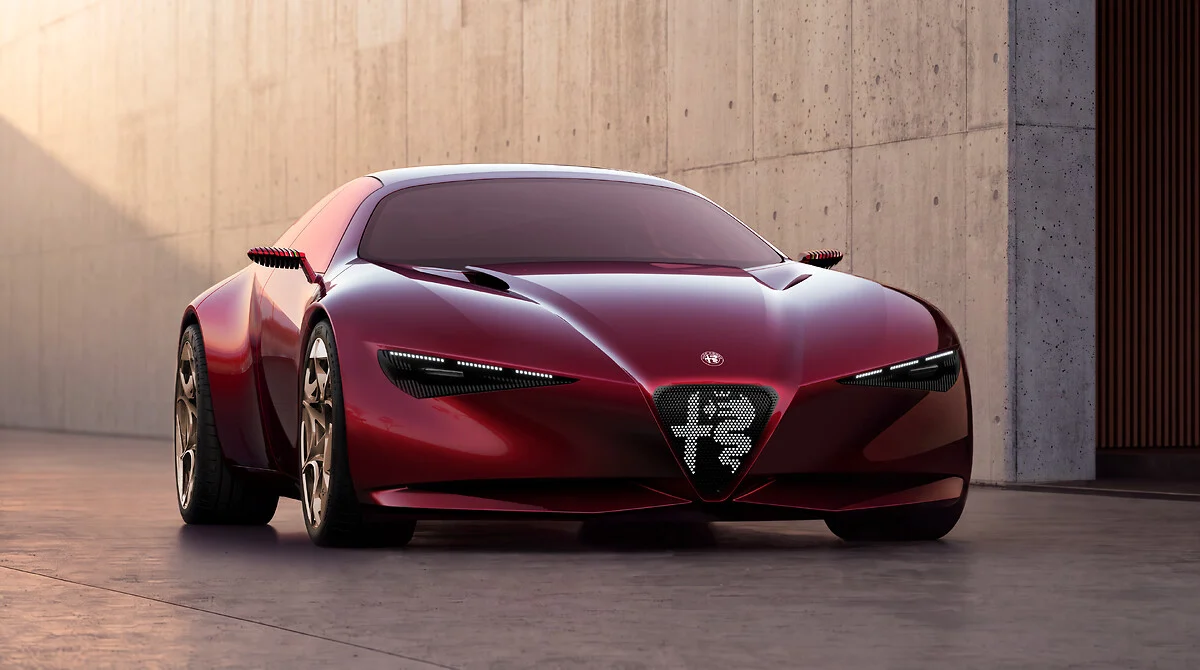
Alfa Romeo has put a bright red question on its Paris stand. Cuorerosso is a 4.7-metre 2+2 coupé with the low, taut proportions of a grand tourer and the stance of something built to be noticed from the far end of a hall. The name joins cuore, heart, to rosso, red. The larger idea is more measured: a concept that sets direction without promising a production car.
Alfa Romeo’s release places three ideas at the centre of the car: Italy, sport and red. Each has a visible role. Italian craft informs the surfaces and cabin materials, sport shapes the stance and controls, and red becomes the colour through which those intentions meet. The company calls Cuorerosso a manifesto for what comes next. The word is useful because the concept offers a direction while the details of any future model remain open.
That distinction matters. Alfa Romeo presents Cuorerosso as a manifesto for the company’s future design and technology, with no production date, price or final specification attached. Its lines may inform future models, and the brand says its next cars will use flexible, multi-energy architectures. The concept has a clear job on the stand: make that broad ambition tangible in a car people can walk around, study closely and imagine on a road.
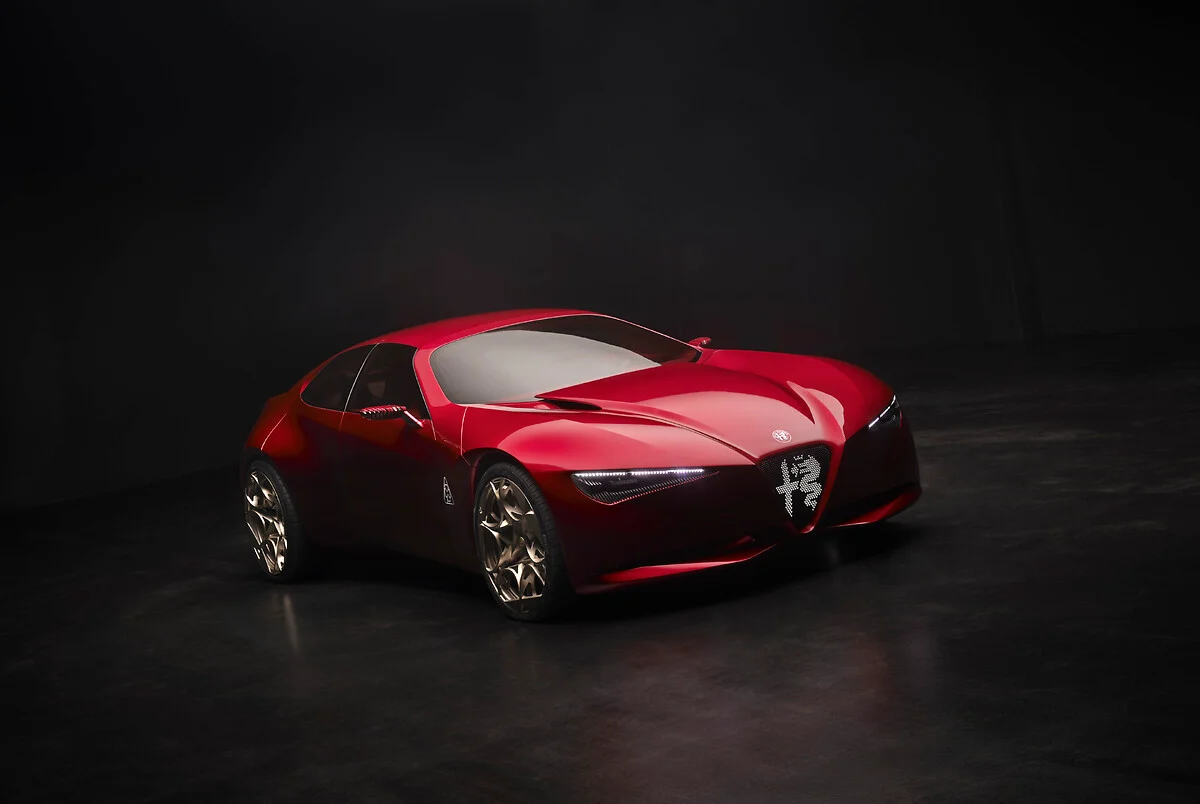
An official studio portrait sets the full Cuorerosso against a dark background, letting the Liquid Ink Red body carry the light.Photograph: Alfa Romeo / Stellantis Media
The proportions do much of the talking. The cabin sits low between a long bonnet and a short rear, while the 2,930 mm wheelbase gives the two-plus-two layout a generous span between the axles. At 4,700 mm long, 1,980 mm wide and 1,331 mm high, Cuorerosso occupies the dimensions of a substantial sports coupé. Alfa Romeo lists its weight at 1,750 kg.
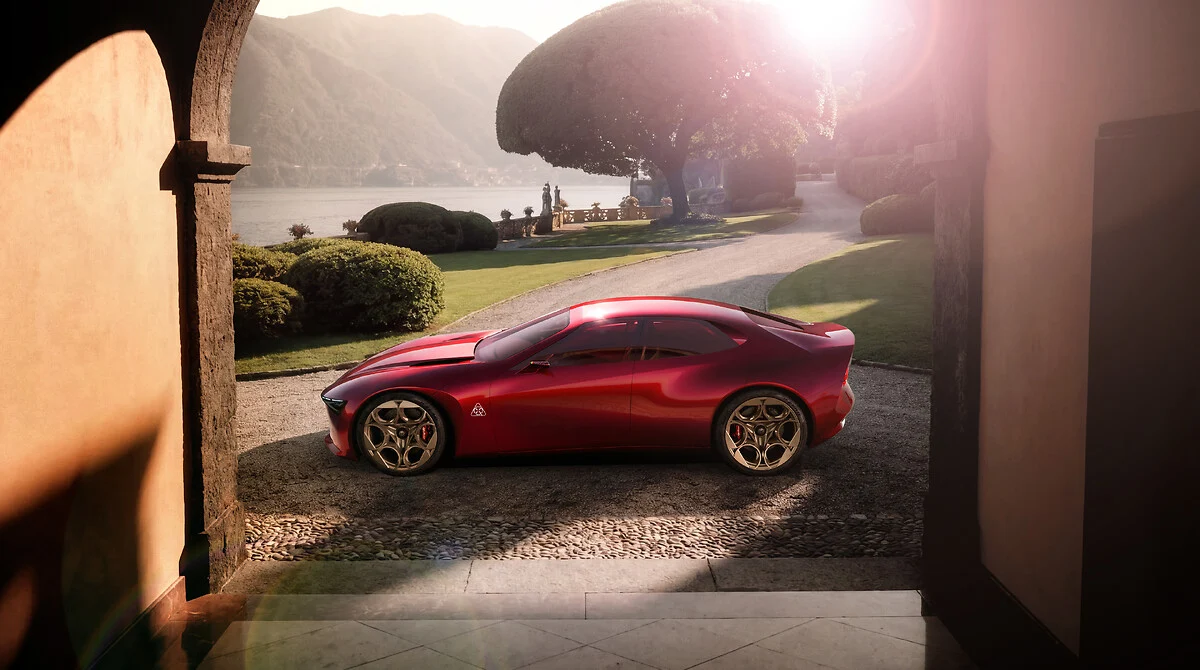
The dimensions give the car room to carry a long, uninterrupted side profile and four individual seats within the same confident outline. The roof is low enough to make the body look taut, while the long interval between the axles keeps the cabin from appearing perched on top of the car. Alfa Romeo gives the concept a weight of 1,750 kg, a useful reminder that this is a substantial technology and design study. The brief is about proportion and driver connection as much as outright lightness.
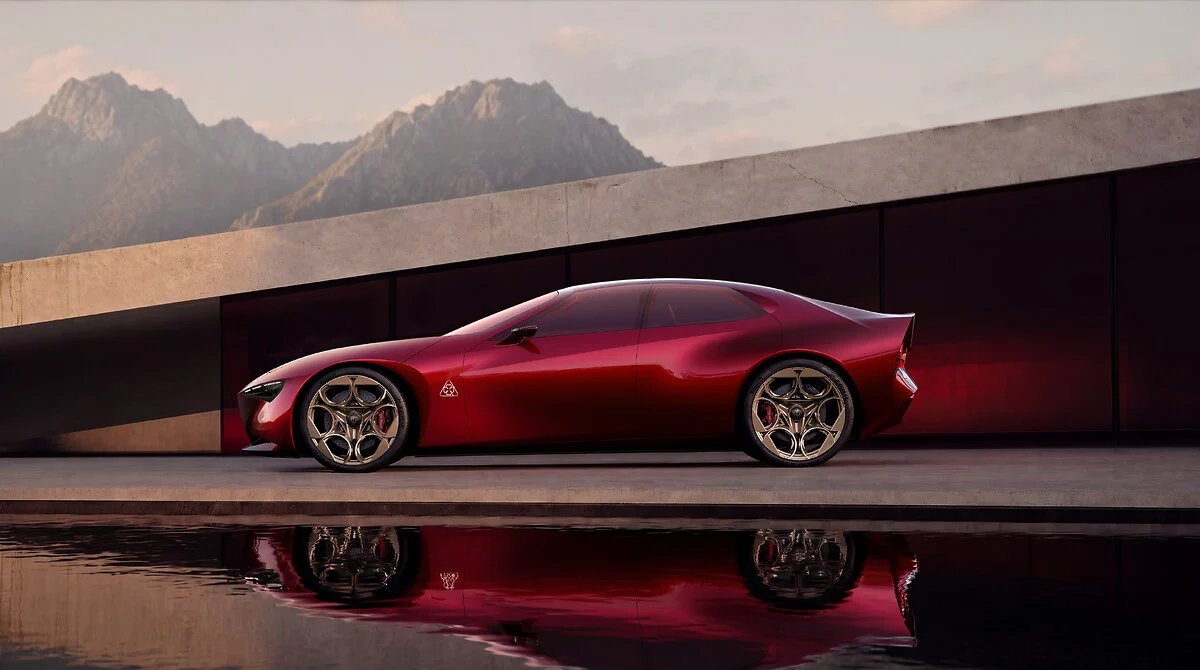
The side view in open light makes the long roofline, low glasshouse and short rear easy to read against the courtyard architecture.Photograph: Alfa Romeo / Stellantis Media
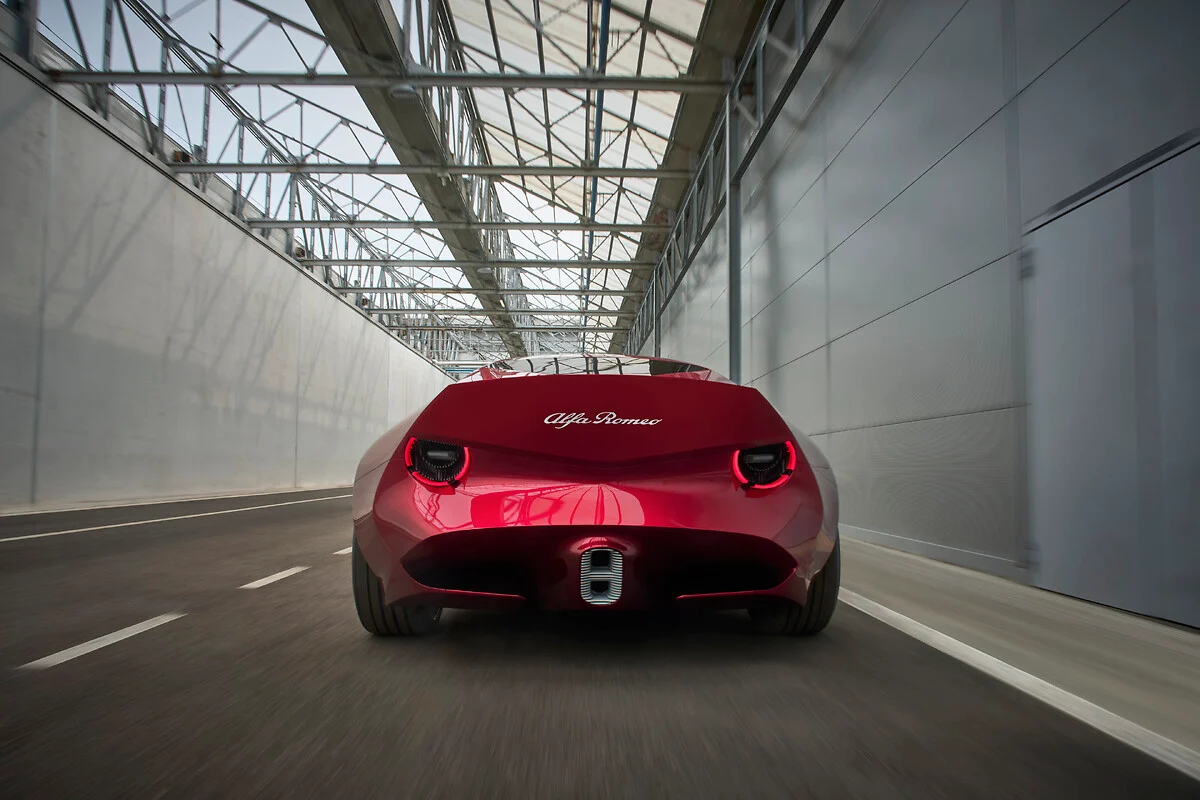
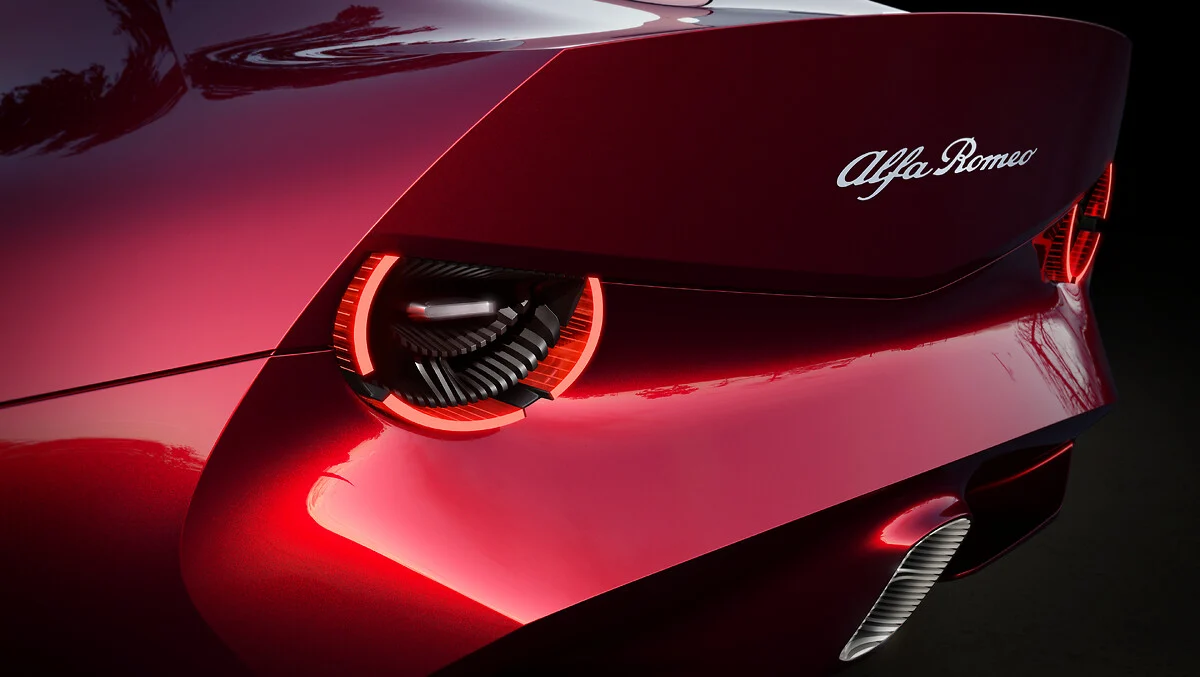
The rear draws on the coda tronca, the cut-off tail used by several of the marque’s most memorable competition and road cars. Here the squared termination sits above an integrated low diffuser. Alfa Romeo gives the concept a drag coefficient of 0.28, a notable figure for a car whose stance is meant to feel muscular. The design team has tried to make the visual drama carry a functional explanation.
Alfa Romeo links that figure to three elements working together: the continuous body shape, the truncated tail and the diffuser integrated into the lower bodywork. The wedge line travels from the front towards the rear and ends at the cut-off tail. It gives the side of the car a sense of stored movement, while the rear window is shaped like the Scudetto and sits within the body volume. The details make the car’s silhouette feel considered from either end.
The rear view shows how the cut-off tail and full-width lamp treatment finish the concept’s long, low profile.Photograph: Alfa Romeo / Stellantis Media
Small details ask to be found at walking pace. The roof opens the doors through a touch-controlled system. Rear-hinged doors clear a wide entry, flush windows and hidden handles keep the sides clean, and the wheels reinterpret the telephone-dial form in forged metal. At the front, the Scudetto and trilobo retain their familiar place while the lighting draws a sharper, more contemporary outline.
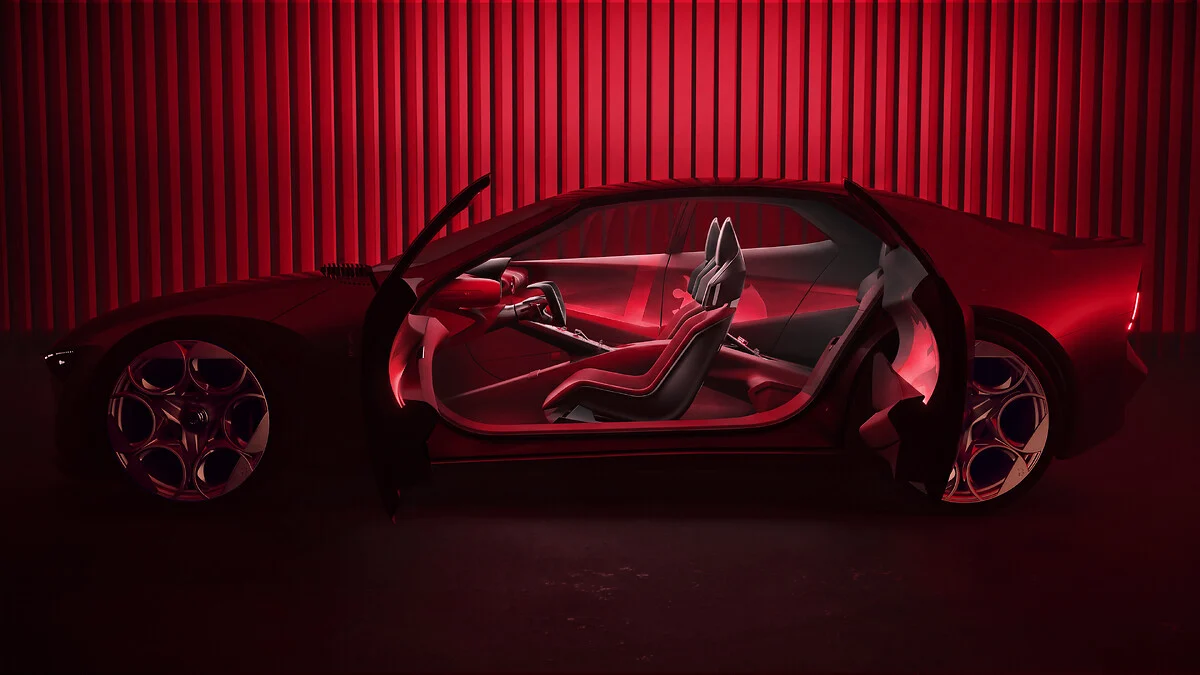
With its counter-opening doors raised, Cuorerosso reveals the red cabin as part of the exterior sculpture.Photograph: Alfa Romeo / Stellantis Media
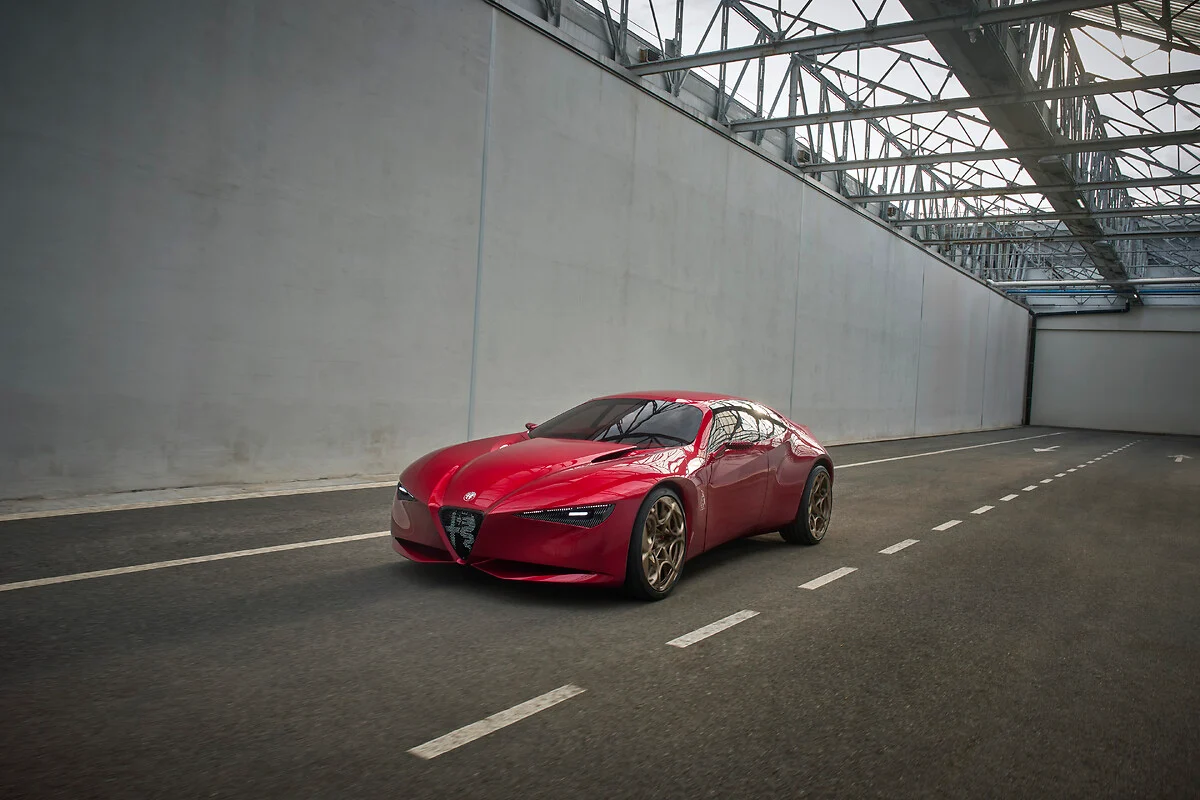
A front three-quarter view places Cuorerosso inside a bright, glass-roofed hall, where daylight travels along the bonnet and shoulder line.Photograph: Alfa Romeo / Stellantis Media
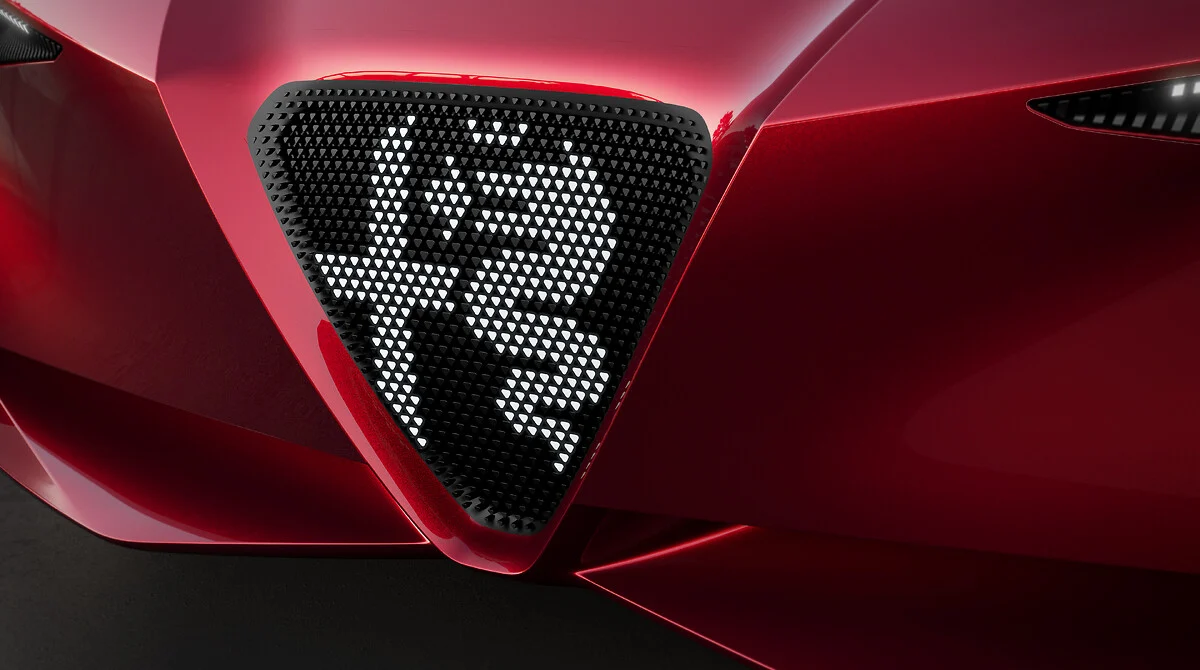
The illuminated Scudetto turns Alfa Romeo’s familiar shield into a close-up study in light and surface.Photograph: Alfa Romeo / Stellantis Media
A close view of the front lamp shows the small repeated elements that give the Cuorerosso its distinctive lighting signature.Photograph: Alfa Romeo / Stellantis Media
The nose carries the clearest piece of Alfa Romeo identity. The Scudetto rises out of the sculpted bonnet, with a pattern of small backlit triangles that references the Cross and Biscione. Alfa Romeo says the same light motif appears as a welcome signal for the driver. The idea makes the front end recognisable in darkness, while giving the concept a small ritual before a journey begins.
There is hardware behind the theatre. Alfa Romeo lists air suspension and Brembo carbon-ceramic brakes with specific calipers, and the forged wheels reinterpret the telephone-dial motif through six circular forms arranged across three spokes. Openings and triangular details are intended to reduce visual mass and help aerodynamic efficiency. The Quadrifoglio badge appears as an emblem of the performance direction Alfa wants the concept to carry, with the company careful to keep the powertrain itself in the realm of possibility.
Alfa Romeo says its Centro Stile moved from the first sketches to three-dimensional modelling after only a week or two, working with the body as one continuous volume. The team began without wheels, glass or trim, then shaped the mass until the proportions felt right. It is an almost sculptural approach to a car, and it helps explain why the surfaces seem to flow across the body without a hard visual interruption.
The studio describes this as Bellezza Necessaria, a beauty made by removing the superfluous and asking each component to earn its place. That principle can be read in the flush glazing, disappearing handles and the roof-mounted touch controls for the doors. The rear-hinged doors open up the cabin dramatically, then leave the side of the car clean when they close. The effect is theatrical, though its purpose is also practical access to a four-seat interior.
The paint has its own small performance. Liquid Ink starts with a fine aluminium base, then gains a translucent colour layer that changes character as the viewing angle shifts. Red can deepen towards black across the body. In a concept designed to be read as both machine and object, that movement of light gives the colour a job beyond decoration.
The colour works especially well against the reflective setting in the official gallery. The body seems to change from bright red to a much darker wine shade as the light moves across the shoulder and rear quarter. The shifting finish helps explain why Alfa Romeo has chosen a concept that rewards a slow walk around it. There is a full silhouette to take in first, then a series of small changes in surface, reflection and detail.
A long profile and its reflection bring the concept’s continuous surfaces into view against the Paris stand’s darker backdrop.Photograph: Alfa Romeo / Stellantis Media
The cockpit keeps the driver in the conversation
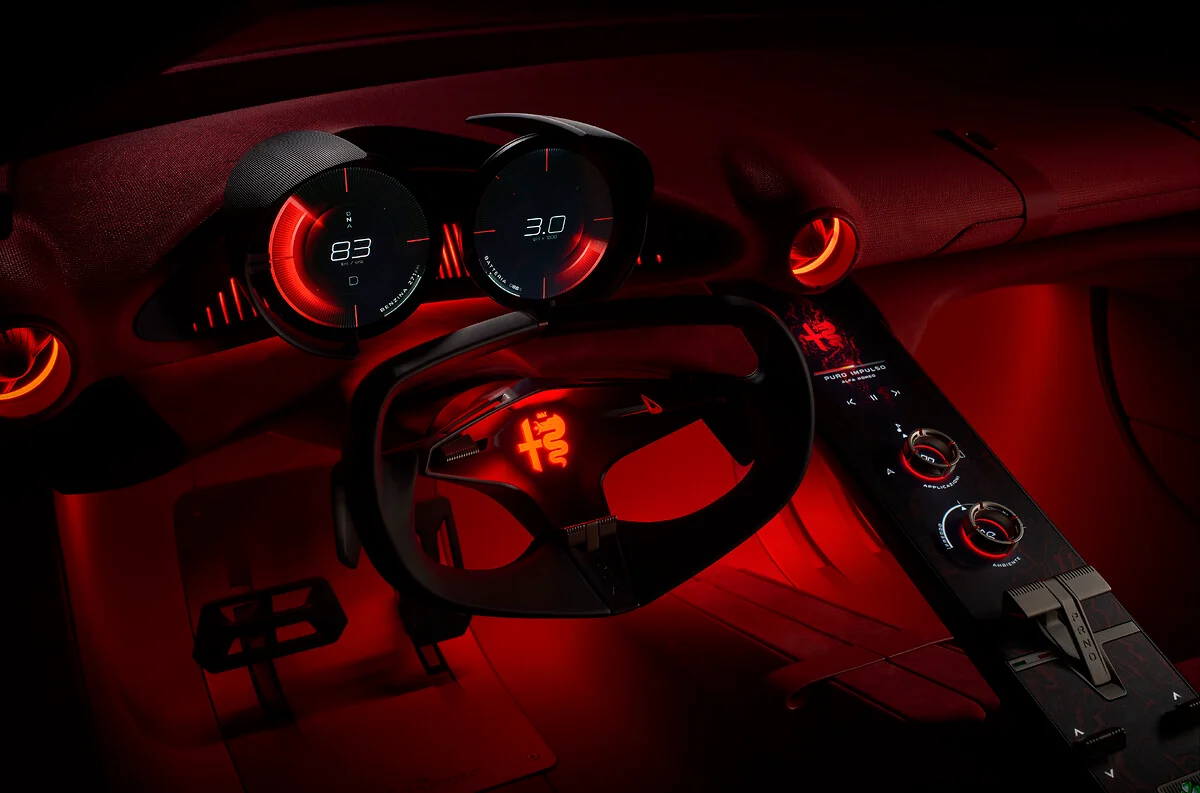
Inside, Alfa Romeo has made the instrument panel part of the car’s character. The Cannocchiale Vivente, or living binnacle, changes its physical arrangement according to the drive mode. Two separate dials can move into a single display. The idea treats the instruments as a piece of mechanical theatre, though one that still has to earn its place by showing the driver the information needed for the road.
The dashboard takes inspiration from the architecture of the 1967 33 Stradale and its modern counterpart. Its thin horizontal sweep continues into the doors, making the cabin appear wider and giving the instruments a calm, low line across the driver’s view. Alfa Romeo says controls and information appear when they are needed, then recede. That is a more ambitious brief than fitting another screen. It asks the interface to support concentration while still giving the driver something physical to engage with.
The cockpit gathers its instruments, central controls and steering wheel into a close, red-lit view around the driver.Photograph: Alfa Romeo / Stellantis Media
A steer-by-wire system removes the direct mechanical link between steering wheel and front wheels. That is an important technical choice, and one that will be judged by feel as much as by its packaging advantages. Alfa Romeo’s design brief is to preserve a close, legible connection between driver and car while adding the freedom to alter the response. The concept gives the wheel and its changing displays a central role in that conversation.
Alfa Romeo calls the steering idea Con-tatto Volante. The three-spoke wheel retains a physical, analogue presence, with the company describing haptic and acoustic feedback from the controls as part of the connection. That matters because steer-by-wire shifts much of the driver’s information into a software-controlled system. The concept’s answer is to make the wheel feel deliberate and communicative, then let the ratio and response change around it. A production car would need to make that promise convincing at every speed.
The Magma Display gathers a touch surface, rotary dial, drive-mode selector and toggle controls on the centre tunnel. Its job is to keep frequently used actions close to hand and to bring the digital interface into the same physical space as the steering wheel. The cabin is built around four separate seats and a long console, with the controls arranged to make the driver feel enclosed without turning the interior into a display gallery.
The four individual seats are trimmed in materials that reflect the project’s Italian craft story. Poltrona Frau nubuck receives a hand-applied colour gradient. The company also describes recycled leather with 60 per cent post-industrial waste, material associated with Luna Rossa sailing and recycled carbon fibre mixed with red resin. Lighting changes with the selected mode, becoming quieter when concentration is the priority and more expressive in Quadrifoglio mode.
Alfa presents the material choices as part of the car’s identity, alongside its design details and technology. The cabin brings together Poltrona Frau upholstery, recycled material connected with the Luna Rossa sailing partnership and carbon fibre tinted with red resin. The point is tactile as much as environmental. The company wants the interior to feel crafted and sporting, with surfaces that carry a story in the same way the exterior carries the history of the Scudetto and Quadrifoglio.
Cruise, Sport and Quadrifoglio are the named settings, with the central Magma Display and the moving binnacle helping the cabin change its mood. The shift is visible in the light as well as the instruments. In the most focused configuration, the illumination recedes. Quadrifoglio mode dims selected areas and leaves four points of light in the vents, a reference to the cross in the Alfa Romeo badge.
One shape, several possible powertrains
The question of what turns Cuorerosso is deliberately open. Alfa Romeo says the platform direction can accommodate battery-electric, plug-in hybrid, mild-hybrid and full-hybrid configurations across future model lines. These possibilities describe a range of approaches for future cars. Alfa has not confirmed that this exact coupé will reach production in all of them.
That range is the point of the announcement. The company is using the concept to show how a recognisable Alfa Romeo character might travel across different energy systems. The same design language, driver-focused cockpit and sporting intent are meant to survive a change in what powers the car. There is no confirmed production programme attached to Cuorerosso, so these options belong to the brand’s wider direction and should be read as such.
For the most performance-focused interpretation, the company imagines a 2.9-litre V6 full-hybrid system with Q4 all-wheel drive, a torque-converter automatic and a carbon-fibre driveshaft. This remains a concept scenario. Alfa has announced no output figure or acceleration claim, and has made no promise that a Quadrifoglio coupé is on its way.
There is something revealing in the way Alfa Romeo has described that imagined Quadrifoglio. It gives the brand permission to state the character it wants from a future flagship, while leaving the engineering specification open. Q4, the V6 and a carbon-fibre driveshaft point towards a serious performance brief. The absence of power and acceleration figures is equally useful. It keeps the conversation on design and intent, where the company has chosen to place this car.
The broader ambition is easier to state. Alfa Romeo wants each car’s character to lead the choice of powertrain. Cuorerosso gives that ambition a physical form: low roof, long bonnet, focused cockpit and space for a range of electrified systems.
A manifesto has to survive the walk back to the road
Concept cars are allowed to make an argument in one gesture. The harder task comes when the same decisions meet packaging, cost, safety rules and the daily use expected of a real car. Cuorerosso can be admired on a show stand for its red paint and sculptural surfaces, then assessed more closely for what its details imply about the next Alfa Romeo cabin, its materials and its steering.
The Cuorerosso’s most persuasive feature may be the space it leaves for multiple answer. Its central promise is broader: Alfa Romeo intends to carry its sporting identity into a period of electrification without making the driver an afterthought. The Paris concept has made the case in red. The next step will be to see which of its ideas find their way onto the road.
A concept has to leave room for the next conversation. Cuorerosso has done that by giving Alfa Romeo a tangible way to discuss proportion, materials, controls and electrification in one place. Its best ideas are easy to identify: the cut-off tail, the moving binnacle, the tactile wheel and a body whose red finish seems to alter with the light. The road will decide which ideas can live beyond the stand. For now, the car makes the company’s direction unusually clear.
Comments0
Join the ViPeople conversationSign in with Google to comment, like and save stories.Continue with Google